
Air conditioning lifting with a crane truck in Barcelona: what to check before the lift
Some air conditioning jobs are wrapped up in a morning. Others get stuck before the work even starts. In Barcelona, that happens all the time: narrow streets, facades with very little clearance, inner courtyards, awkward roof access, or units that simply will not fit through the stairwell or the lift. At that point, improvising usually costs money. Sometimes it means doing the lift twice.
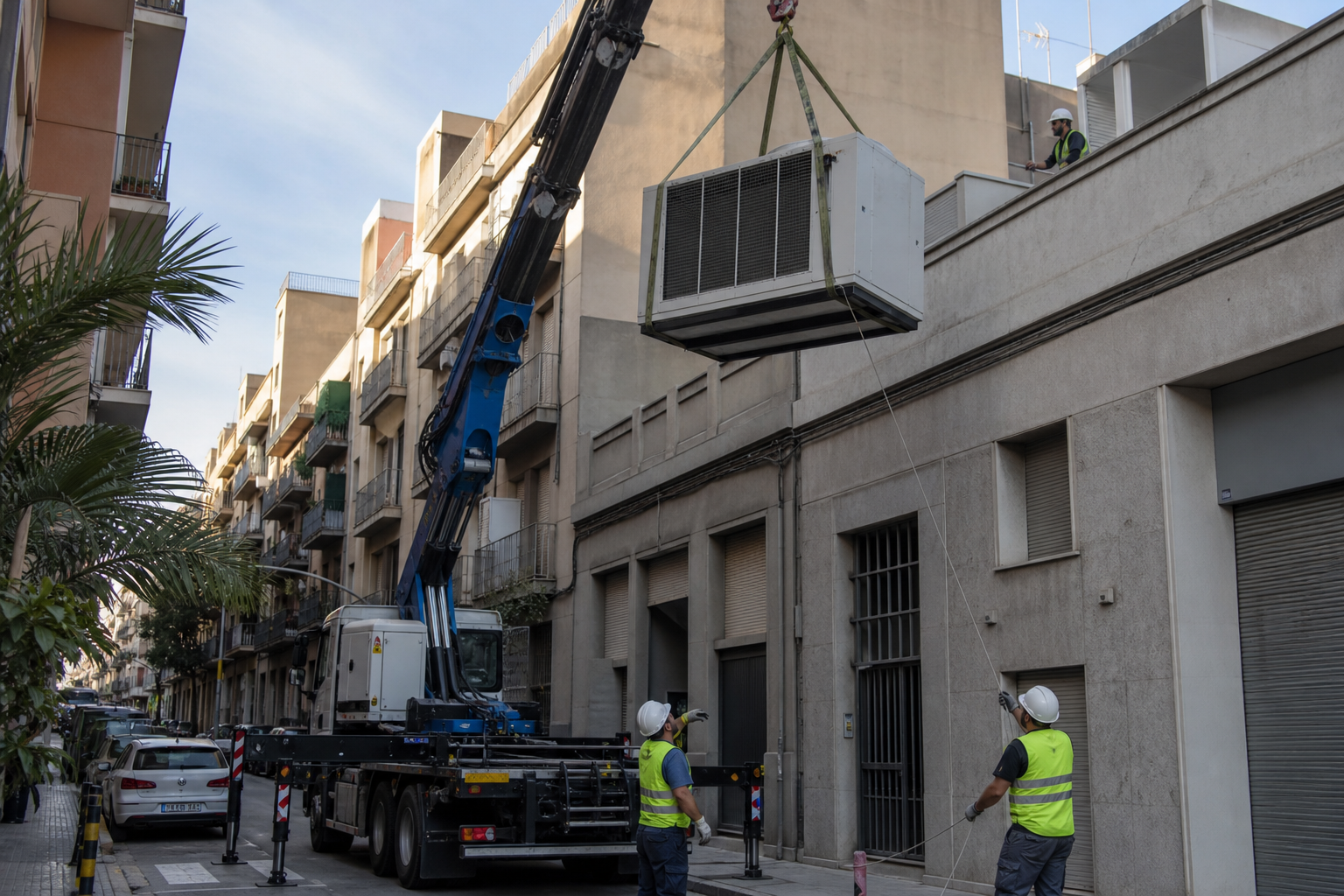
A crane assisted air conditioning lift becomes necessary when the outdoor unit or the full system has to be placed on a rooftop, roof deck, technical terrace or facade where manual handling is not a realistic option. It also makes sense when the weight, size or layout of the building makes it impractical to move the load through the inside of the property.
If you are asking for a quote, it helps to have a few key details ready. That makes the lift easier to assess, cuts down on back and forth, and gives everyone less room for error.
When a crane truck is needed to lift an air conditioner
A crane is not necessary for every installation, but there are situations where it makes sense to plan for one from the start.
That usually includes cases like these:
- Large or heavy outdoor units.
- Installations on rooftops or roof decks with poor access.
- Facades where the load cannot be handled from inside the building.
- Inner courtyards with very limited space and a need to work at height.
- Residential blocks or commercial premises where removing joinery, railings or interior access points would be more disruptive than carrying out a controlled lift.
- Replacement of older systems in buildings where access was already difficult and is now even worse.
It is also common in office refurbishments, warehouses, retail units and residential buildings where the installer needs the equipment delivered to one specific point so installation can start without wasting time on extra handling.
In Barcelona and nearby areas, this comes up often because of the urban layout itself. Working in a warehouse with wide access is one thing. Working in a street with parked cars, projecting balconies and barely enough room to stabilise the vehicle is something else.
What information to prepare before asking for a quote
Requesting a quote without details usually leads to one of two outcomes: a very open ended price or a site visit that could have been streamlined. The more real information you can provide, the easier it is to assess the lift properly.
If you already know access is tight, the unit has to go to the roof, or the equipment is bulky, asking for a quote early usually saves time. If the information is also organised clearly, the response tends to be much more useful.
Height, weight and dimensions
This is the starting point. You need to know:
- Which unit is being lifted.
- How much it weighs.
- Its dimensions.
- Whether it is packed, palletised or fitted with accessories.
You do not need to speak like a lifting engineer, but the details do need to be useful. A compact outdoor unit does not create the same situation as a large industrial HVAC system. Weight matters, but dimensions matter too, especially if the load has to clear facade overhangs, pass above railings or be set down in a tight area.
If you do not have the technical data sheet at hand, clear photos of the plate or model number help a lot.
Delivery point and lifting point
Another important detail: where the equipment arrives is not necessarily where it needs to be placed.
It helps to specify:
- Whether unloading takes place at street level, inside a warehouse or on a worksite.
- Whether the lift ends at the facade, terrace, roof or inner courtyard.
- Whether the equipment can be left in an approximate area or needs to be placed quite precisely so the installer can receive it.
That route changes the job completely. Lifting a unit onto an open rooftop is not the same as threading it into an inner courtyard with very little clearance and limited visibility.
Obstacles, street conditions and permits
This is where a lot of surprises show up. Before requesting a quote, it is worth checking:
- Street width.
- Whether the truck can realistically park and stabilise.
- Trees, lampposts, road signs, canopies or cables.
- Balconies, facade projections or other overhanging elements.
- Times of day with heavier traffic or more difficulty carrying out the lift.
- Whether space has to be reserved or permits need to be arranged.
A general street photo and another of the work area are very helpful. If you can also mark where you think the truck could operate from, even better.
What to send to get a clearer quote
If you want to avoid several rounds of messages, the most useful approach is usually to send everything together:
- Photos of the equipment.
- Photos of the facade, roof or courtyard.
- A photo of the street or area where the truck would be positioned.
- Weight and dimensions, even if initially approximate.
- The exact service address.
- The height or floor level where the load must be placed.
- The planned day or approximate time slot.
- Whether you only need the lift or also transport for the equipment.
With that, it is already possible to see whether the lift is feasible, whether a prior site visit is needed, or whether something should be adjusted before setting a date.
How a safe lift is organised on a facade or rooftop
Safety is not just about bringing the right crane. Most of it comes down to having the lift properly thought through before the truck arrives.
For an air conditioning lift with a crane, the first step is usually checking whether access is workable, where the truck can operate from and what working radius is required. After that, the lifting method, pick point and final placement of the unit are defined. If installers, site crews or maintenance teams are involved, coordination matters too.
In practice, a well prepared lift usually depends on a few simple things:
- Real photos of the building and its surroundings.
- Approximate height and distance measurements.
- Equipment details.
- A clear working schedule.
- A contact person on site or in the building.
- Confirmation of whether the unit is already being transported or also needs collecting.
When the installation is on a facade, roof or inner courtyard, clear visibility of the route avoids a lot of problems. Sometimes the lift is possible, just not from the point the client had in mind. In other cases, it makes sense to work at a specific time so a difficult street is not blocked longer than necessary.
Common mistakes that make the operation more expensive
This is where money is often lost for no good reason.
The first mistake is asking for a quote without photos or measurements. There is no need for a formal report, but there does need to be a real basis for planning. Otherwise the service is priced too cautiously or the whole job has to be rethought.
The second mistake is assuming it will all be sorted out on arrival. That rarely works well when the job involves a roof, a narrow facade or a street where the truck has almost no margin to work with.
The operation also becomes more expensive when:
- The real equipment weight is not confirmed.
- Access obstacles are left out.
- Nobody mentions that the lift is into an inner courtyard.
- Transport, unloading and lifting are coordinated separately with no one overseeing the whole job.
- Installers, the building and the crane service are booked into badly matched time slots.
Another common issue is not considering whether the equipment can be received directly at its final position. If it first has to be unloaded, moved elsewhere and then picked up again, the work takes longer and becomes needlessly more complicated.
Why it helps to coordinate transport and crane service with one provider
When equipment transport and lifting are handled separately, sometimes everything goes smoothly. Other times, gaps appear between one part and the next: schedules do not line up, loads are not properly prepared, people are left waiting, or nobody is sure where the material should go.
Coordinating transport and crane service with one provider makes the operation much simpler because it reduces middlemen and avoids each party working from a different understanding of the job. If the same team knows what is being collected, where it is coming from and where it has to end up, it is easier to manage timings and solve issues as they come up.
In HVAC work, that makes a real difference. Especially when access is difficult and there is not much time to spare. If the equipment is coming from a warehouse, a site or another location and also has to be lifted onto a roof or facade, having the whole service under one coordination usually gives you more control.
FAQ
Is a site visit always necessary?
Not always. If there are good photos, clear measurements and reliable equipment details, many lifts can be assessed without a visit. When access is especially delicate, a prior visit can prevent problems.
Can an air conditioner be lifted onto a rooftop in a narrow street?
It depends on the real space available to position the truck, the height involved and the obstacles around it. In Barcelona, some streets make this viable and others need a closer review first.
Which photos should I send when asking for a quote?
One of the equipment, one of the facade or roof, one of the access point and another of the street where the truck would need to stand. If you can add approximate measurements, even better.
Can you also handle transport for the equipment?
Yes. It is often the most practical option when you want to avoid separate coordination for collection, delivery and lifting.
If you need to lift an air conditioning unit with a crane in Barcelona, Adik Gruas can assess the job based on the real site conditions. With a few photos, the unit dimensions and the exact placement point, it is much easier to tell you whether the lift is feasible and how it should be planned.
Need to plan a crane truck operation?
Tell us what you need and we will help you assess the best way to organise the service.
Leave A Comment