
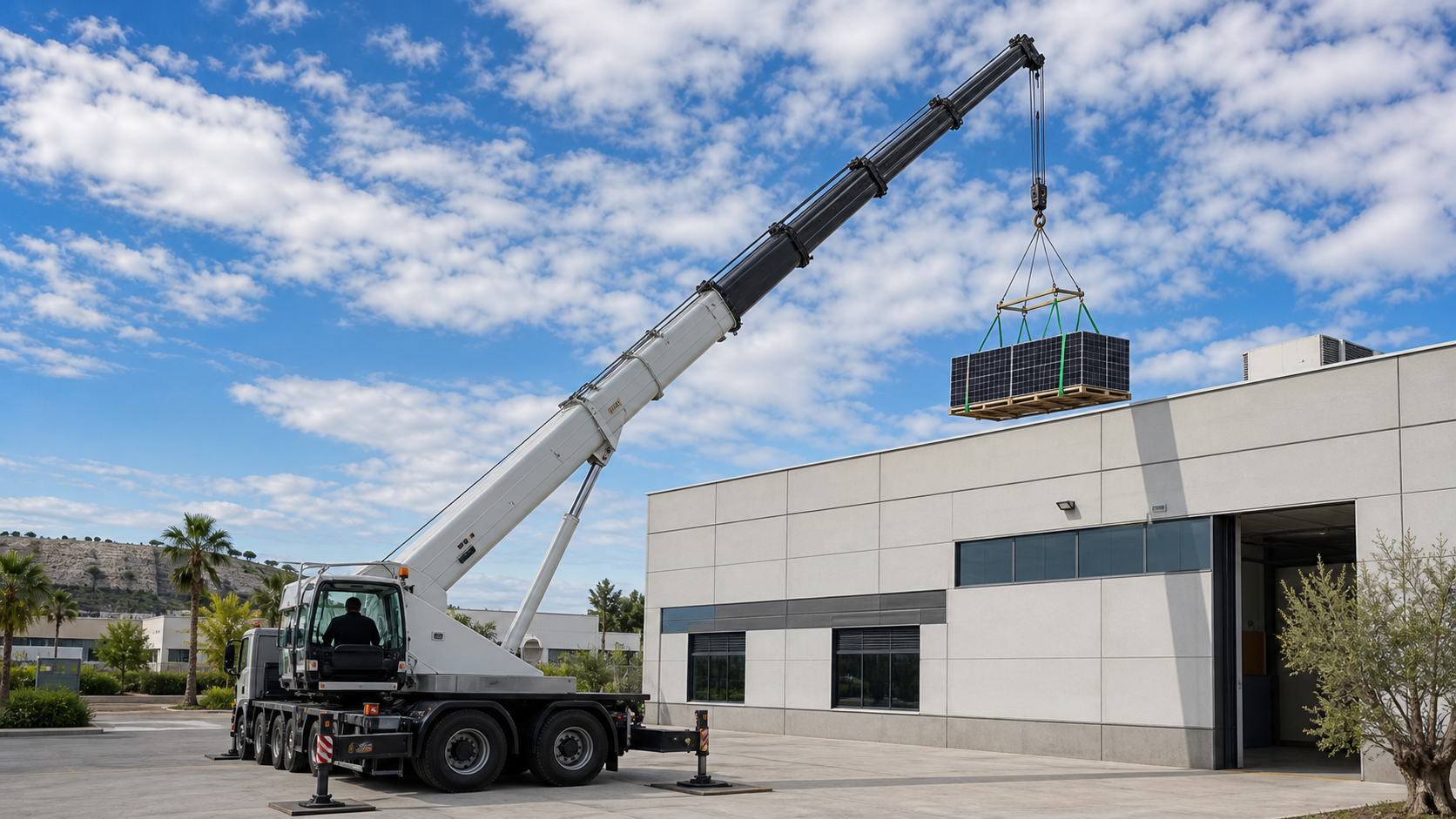
An engineering firm called us recently with a very specific problem. They had 28 panels ready to go onto the roof of a logistics warehouse in Baix Llobregat, two days before final handover to their client. The electrical installer had everything measured. What they did not have was a clear plan to lift 700 kg of racking and panels 11 metres up without blocking activity in the industrial park for half a morning.
That is the kind of project where a crane truck makes the difference between a normal working day and a logistics headache. And it is also the kind of project where not just any vehicle will do. Industrial roofs follow their own rules.
When you need a crane truck for a solar panel lift
A solar installer usually reaches the roof through the warehouse interior staircase. That works for pulling cable, mounting inverters and running tests. But the panels and racking are heavy, and the packs do not fit through a stairwell opening. That is where the crane truck comes in.
Flat industrial roof
On flat roofs, the truck parks alongside the building and lifts the palletised packs straight to the roof edge. The crane operator works with the rooftop crew, which receives and distributes. It is the fastest option when there is perimeter space to park the truck with the outriggers extended.
Pitched roof with awkward access
On pitched roofs the picture changes. Here the truck cannot always park right at the edge. Sometimes you have to lift diagonally over inner courtyards or narrow streets. The crane needs more capacity than it looks at first glance, because horizontal reach eats into the useful payload.
When you do not need a crane
Some roofs have easy access from a street or a wide yard. In those cases, an aerial work platform or a forklift can be enough. A crane only pays off when the height, the reach or the weight demand it. The point is not to pick the most expensive option, but the one that actually solves the problem with less risk.
What information to prepare before requesting a quote
A good quote request saves a preliminary visit and cuts a lot of error margin. For solar panel roof lifts with a crane, we usually ask our clients for the same data:
Weight, number of packs and dimensions
It depends on whether the panels arrive on a full pallet, in packs of 8 to 12 units or already pre-assembled with the racking. A standard pallet weighs between 600 and 900 kg. If the roof receives more than one layer, the rhythm has to be planned so weight does not pile up at one point.
Access to the building and safety perimeter
We need to know if there are fences, overhead power lines, awnings, advertising banners or pedestrian zones by the edge. These elements define the real working radius of the outriggers and sometimes force the truck to shift position by several metres.
Horizontal distance to the lift point
Height alone does not define the job. A roof at 12 metres located 8 metres from the edge demands more capacity than a roof at 9 metres with the truck close to the wall. The practical rule is: the higher and the further, the larger the crane has to be.
How the manoeuvre is planned on an industrial roof
The manoeuvre is planned the day before, on plan if possible. We go through lift points, weight per pack, truck position and load sequence. If there are several stops, we mark them with temporary paint on the ground.
On the day of the manoeuvre, the rooftop crew wears a life line and harness, the crane operator works with his team on the ground and a safety coordinator bridges the two. Communication runs on radio or on confirmed voice signals. Nothing is improvised.
On roofs in active industrial sites, the job is scheduled in a time window that affects the rest of the warehouse as little as possible. Sometimes that means starting at seven in the morning, before the first shift begins.
Common mistakes that inflate the cost or block the operation
- Asking for a quote with only the roof height. Without horizontal distance or weight per pack, only an indicative price can be given.
- Forgetting about overhead power lines. A medium-voltage line forces safe distances that can block the manoeuvre.
- Not reserving perimeter space. Without room for the outriggers, the crane loses up to 30% of useful capacity.
- Lifting loose panels. Closed, well-slung pallets are better. A loose panel is a panel that flies with the first gust of wind.
- Quoting as if the roof were flat when it is pitched. Pitch changes the support point and often calls for a more experienced operator.
Why combining transport and lifting with a single provider pays off
When an installer subcontracts transport and crane to two different providers, they run into a classic problem: the first one leaves the pallets on the street and the second one charges a waiting fee. The sensible thing is for the same provider to deliver the panels, lift them and leave them on the roof already distributed. Total cost goes down and responsibility stays with a single point of contact.
In our case, that is how we usually work on industrial roofs in Barcelona and the metropolitan area: truck, crane, same operator, one invoice.
FAQ
Can solar panels be lifted at any time of year? Yes. The difference between winter and summer sits more in the later output of the installation than in the manoeuvre itself. What does change is the time window: in summer, midday is avoided because of the heat on the roof.
How long does it take to lift a pallet of panels? Between 8 and 15 minutes per pallet, depending on reach and weight. For a medium industrial installation (50 to 100 kWp), a full morning with coordination between the rooftop crew and the crane operator is normal.
Do you need a municipal permit? In industrial warehouses inside a business park, usually not. In the urban core, or when the truck takes part of the street, yes. We handle it if the request comes with some lead time.
What if there is a power line nearby? It is assessed before the manoeuvre. If the distance is not safe, a temporary cut is requested from the distributor or the operation is repositioned. We never work with a live line inside the boom radius.
If you have a solar PV project on the go or an industrial roof still to execute, we can go over the plans together and give you a fixed figure. Write to us through the Adik Gruas contact form and we will reply on the same working day.