
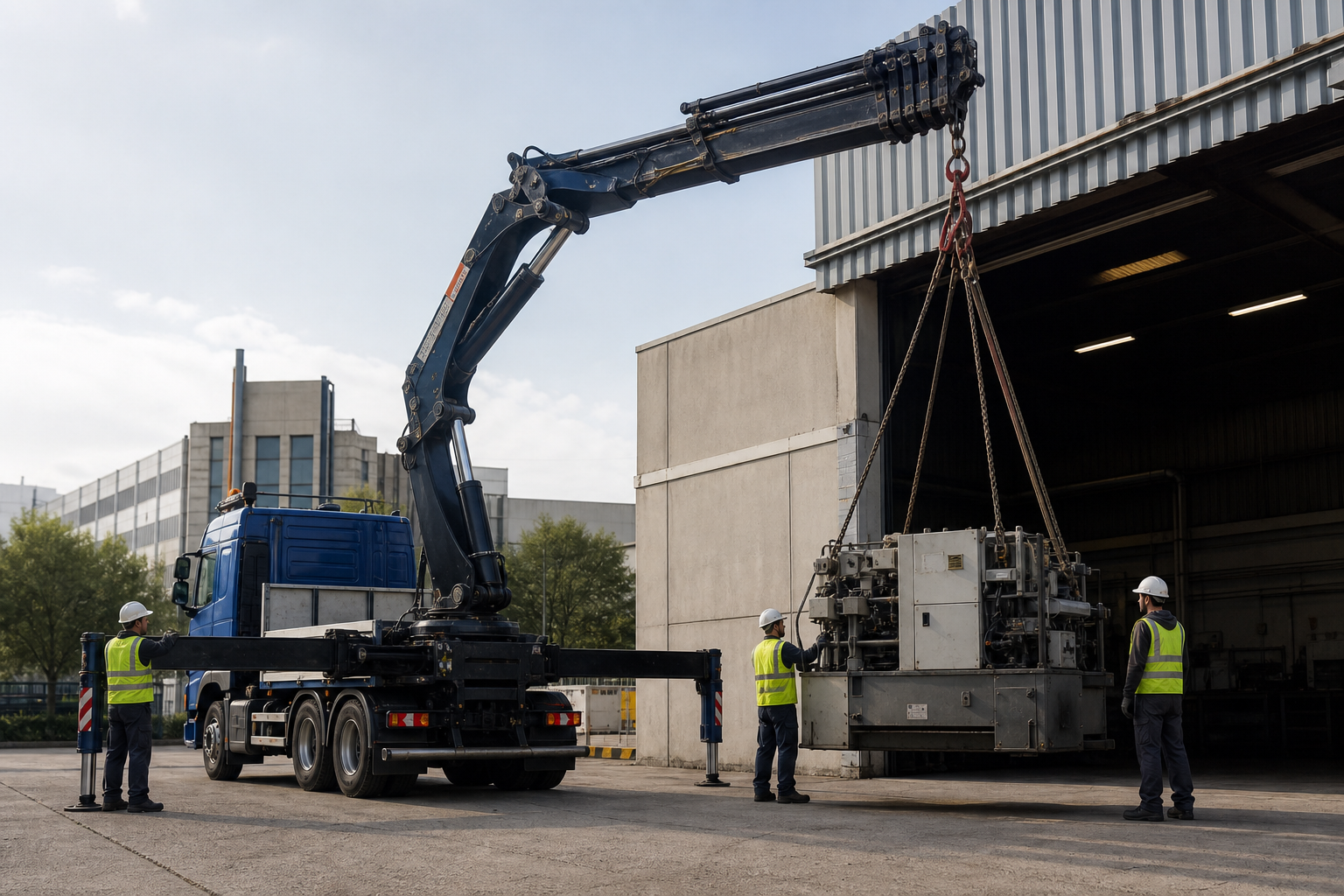
Moving industrial machinery is rarely just a matter of loading it and taking it away. In many cases, the real challenge is the operation itself: getting a machine out of a warehouse, unloading it into a yard with very little space, repositioning it inside the plant, or coordinating the move without shutting production down for longer than necessary.
That is where crane truck operations make the difference. Not only because they lift heavy loads, but because they help resolve the whole job properly: access, working radius, vehicle stabilisation, sequence of work, timing and coordination with the company’s own staff.
In industrial settings, small mistakes can be expensive. A wrong weight figure, a doorway that looked wide enough on the drawing but is not in reality, an unloading point with no clean space to manoeuvre, or downtime that does not fit the production schedule can turn a simple move into a wasted day.
That is why it pays to prepare the operation with useful information and with a provider used to this kind of work.
What a crane truck operation for industrial machinery includes
When a company looks for a crane truck for industrial machinery, it usually needs one or more of these tasks:
- Loading machinery at origin.
- Unloading at destination.
- Internal movement or repositioning.
- Support for installation or dismantling.
- A specific lift to clear access issues, level changes or areas where a forklift is not enough.
- Coordination between transport and lifting.
Not every job is the same. Some machines only need a straightforward load and direct unload. Others require more precision: placing equipment next to a base frame, bringing it in through one particular side, repositioning it inside a warehouse, or working within a tight time window because production cannot be stopped for long.
Conditions also vary a lot from one sector to another. Moving machinery in an industrial building with a large yard is one thing. Doing it in an urban workshop in Barcelona, in premises with tight access, or in a plant where the operation has to coexist with people, materials and ongoing production rhythms is something else.
Minimum information needed to plan the job properly
Requesting a quote for an operation with very little data almost always leads to pricing that is too open ended or to later revisions. If you want a more accurate response, there is some information worth gathering from the start.
Weight, dimensions and centre of gravity
The basics are knowing which machine is being moved and what it actually weighs. It sounds obvious, but many incidents start with approximate figures that do not match reality.
Beyond the weight, it is useful to know:
- The machine’s length, width and height.
- Whether it has removable accessories or protruding parts.
- Whether it sits on a base frame, legs, metal structure or packaging.
- Whether the centre of gravity is balanced or offset.
- Whether the manufacturer has defined lifting points.
You do not need to prepare a perfect technical sheet, but you do need to share whatever documentation exists. A photo of the plate, the model reference or the manual can help a lot. If the machine has been moved before, that matters too.
Access, working radius and stabilising space
This is where a large part of the real work sits. An operation that looks viable on paper can become difficult because of a narrow access point, an undersized doorway, ground conditions that limit stabilisers, or an outdoor area with too little space to position the truck.
It helps to review and explain:
- How the vehicle enters the warehouse or site.
- Where it can be stabilised.
- How much free space there is around it.
- Whether there are pillars, canopies, enclosures, cables or internal traffic.
- The distance between the support point and the place where the machine has to be set down.
- Whether the ground inside or outside has any limitations.
When we talk about working radius, there is no need to use technical language if you are not used to it. Real distances and photos from several angles are enough to make the assessment far more useful than a generic explanation.
Timings, production stoppage and coordination
In B2B work, this point matters as much as the move itself. Many companies do not just need a provider that can lift a machine. They need one that can adapt to a specific work window.
For example:
- An operation before opening hours.
- Unloading during a shift change.
- Repositioning during a maintenance shutdown.
- Loading and dispatch on the same day to avoid taking up space.
- Coordination with fitters, electricians or maintenance teams.
If that information is shared from the start, planning improves immediately. It is not simply a case of arriving, doing the job and leaving. Sometimes the real issue is fitting the operation into the plant’s actual pace.
When it makes sense to combine transport and lifting in one service
Some companies already have transport arranged and only need crane support. In other cases, combining transport and lifting makes the whole operation much easier.
It is usually worth doing when:
- The machine is collected in one place and delivered to another with technical unloading.
- The job involves loading, moving and setting the equipment down in a usable position.
- The time window is short and relying on several providers is not ideal.
- The machine needs continuous oversight from origin to destination.
- Unloading and repositioning are part of the same job.
Keeping transport and lifting under one coordination avoids a lot of misunderstandings. Nobody is arguing at the last minute about how the load was prepared, where it should be left, or who is responsible for waiting because the next provider has not arrived yet.
With industrial machinery, that continuity usually saves time. More importantly, it stops the operation from being broken into separate stages that no one is supervising as a whole.
Common risks that drive up time and cost
Extra costs do not usually come from one major incident. More often, they build up through a chain of avoidable mistakes.
The most common are these:
- Weight estimated incorrectly.
- Old or insufficient photos.
- Access measured by eye.
- Missing information about obstacles.
- No clear plan for the exact unloading position.
- Everyone involved scheduled at different times.
- The work area not cleared before arrival.
- Assuming the job ends once the machine touches the ground, when it still needs to be repositioned.
It is also common for a company to ask for a price to move one machine and then, once the work starts, a second unplanned stage appears: rotating it, taking it further inside, getting it over a kerb, placing it next to another line, or waiting for a third party to free up space.
Those details change both the timing and the equipment needed. That is why it is better to describe the full operation than to sum it up in a single sentence.
Situations where a prior site visit saves trouble
A prior visit is not always necessary, but there are situations where it is worth it.
For example:
- Very bulky machinery or irregular geometry.
- Plants with difficult access.
- Indoor unloading with little room to work.
- Operations in Barcelona and nearby areas with clear urban constraints.
- Jobs involving several teams at once.
- Delicate repositioning next to other machines or active lines.
A prior visit does not automatically make the service more expensive. In many cases, it prevents planning mistakes and allows the service to be tailored more accurately. In an industrial operation, that usually pays off.
FAQ
What does Adik Gruas need to assess an operation?
Photos, weight, dimensions, loading point, unloading point and a clear explanation of where the machine needs to end up. If you can also specify timings and plant conditions, even better.
Can you handle loading, transport and unloading in one service?
Yes. When the job requires it, coordinating everything through one provider usually makes the process much simpler.
Is it necessary to stop production?
It depends on the operation and the environment. In some cases, it is enough to cordon off an area. In others, it makes more sense to work during a shutdown window to avoid interference.
Do you work in Barcelona and nearby areas?
Yes. And that matters because many operations change significantly depending on urban access, available outside space and the conditions at the unloading point.
If your company needs to load, unload, transport or reposition industrial machinery, Adik Gruas can assess the job based on the real working conditions. With photos, dimensions, weight and a clear description of the access and final unloading point, it is much easier to tell you whether the operation fits and how it should be organised.
Need to plan a crane truck operation?
Tell us what you need and we will help you assess the best way to organise the service.
Leave A Comment