
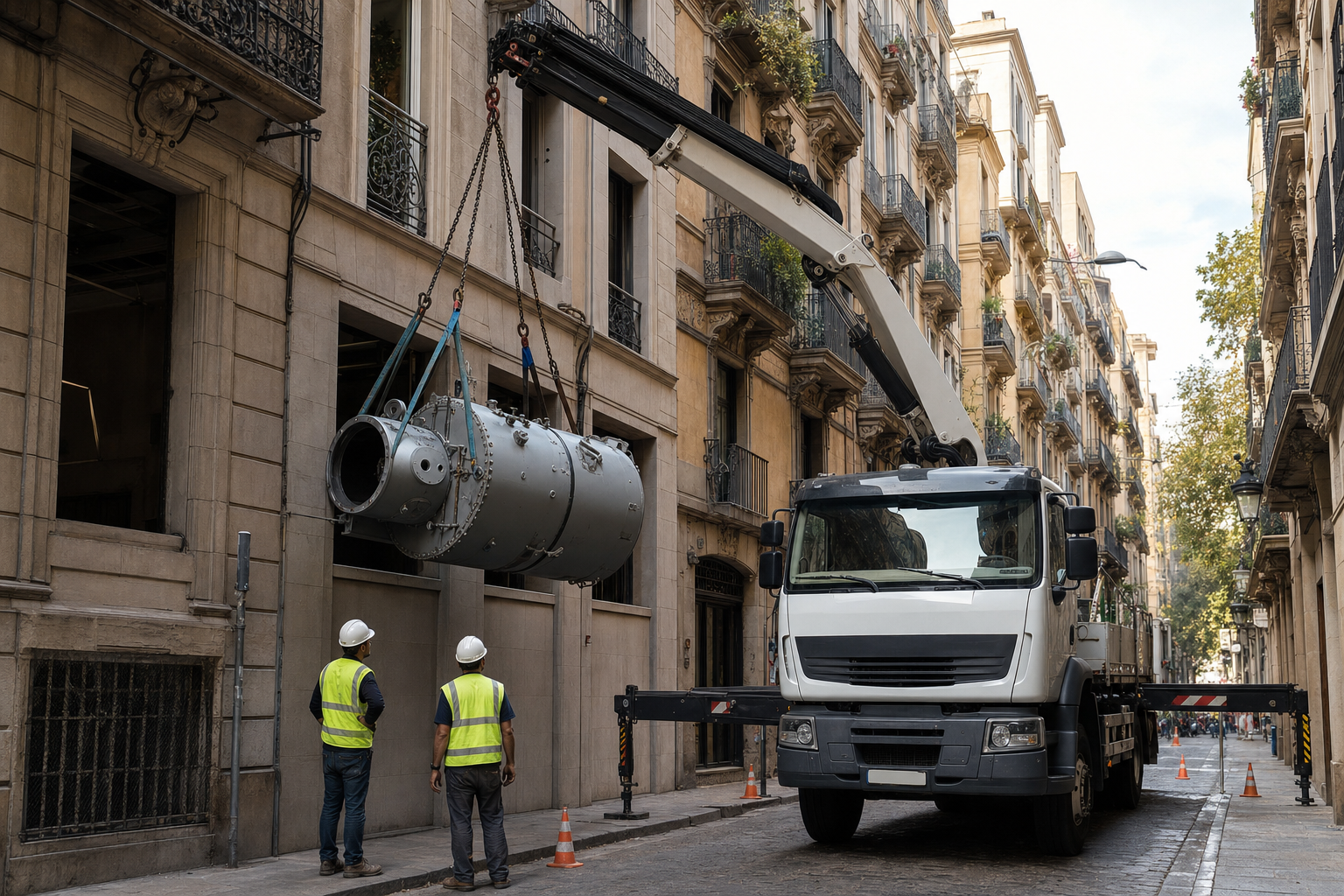
An accountancy practice in Eixample called us last week with a routine job and a very specific problem. They had to take a 2.8 tonne industrial boiler out of a basement in a building on carrer de Girona. The staircase would not take the machine, the pavement ramp had a half-metre step and the street is not wide enough for a low-loader. The answer was to bring in a crane truck from the street, lift the boiler up through an inner courtyard opening and lower it onto the vehicle. All before lunch.
Moving heavy machinery through narrow streets is not an off-the-shelf job. Each building, each inner courtyard and each street has its own headache. What keeps repeating is the feeling of not knowing where to start. That is where an operator who already knows central Barcelona makes the difference between a clean morning and a day of nerves.
When a narrow street forces a crane truck
Most moves are sorted with a ramp and a low-loader. In narrow streets that script breaks down.
When the machinery does not fit through the staircase or the service lift
Industrial boilers, generators, compressors, bakery ovens and large HVAC units usually reach basements through the building’s original staircase. That was designed when the equipment was smaller. Today those machines do not fit through the opening. A crane lets us lift them from the inner courtyard or from the street straight onto the truck without touching the staircase.
When the low-loader cannot park where it should
A standard low-loader runs 13 to 18 metres long and needs a wide turning radius. In Eixample, Gràcia or the Gòtic, a low-loader does not fit and leaves no room for neighbours to get past. A shorter crane truck with an articulated boom drives in, sets its outriggers and works from a more compact footprint.
When the machine is in a basement, cellar or inner courtyard
A crane truck works at a distance. If the machine sits in an inner courtyard with a façade facing the street, the boom reaches over the building and lifts the load from inside. That needs a courtyard with no washing lines, no installations in the vertical line and a minimum gap between the machine and the upper edge.
When lifting has to go over the building
In historic centres some machines can only come in or go out from above. Rooftop HVAC units, industrial antennas, paint booths, tanks. Without a crane, there is no other way.
What we ask before quoting a firm price
A well-prepared quote request saves a preliminary visit and cuts the error margin. We usually ask our clients for the following.
Weight and dimensions of the machine
The spec sheet works, or, if they do not have it, a photo of the machine with a person standing next to it for scale. The manufacturer’s serial number is also useful, since we cross-check it against our internal tables. Without that data we can only give an estimated price.
Photo of the spot from the street
A photo of the doorway, the inner courtyard or the opening the machine has to pass through. That tells us whether there are overhangs, balconies, awnings, cables or signboards that could get in the boom’s way.
Usable street width and cable height
A 4.5 metre street between façades with a low-voltage line at 4.8 metres is not the same as a 6 metre street with underground cabling. If the photo is not clear, we do a preliminary visit with no obligation.
Distance between the doorway and the machine
If the machine is at the back of the premises or behind a column, that changes the plan. The machine may have to be lifted in, rotated inside and lifted again.
Available time window
In urban centres, councils limit the hours for heavy machinery work. We usually operate in the early morning or first thing in the morning to avoid clashing with shop loading and unloading or school runs.
How a narrow-street manoeuvre is planned
A narrow-street manoeuvre is planned before we reach the site.
Preliminary visit and drawings
If the client has drawings of the premises or the building, we review them. If not, a quick visit with a tape measure and a camera confirms widths, heights and obstacles. For complex jobs we bring a checklist with the critical points: boom anchor, outrigger support, clearance, power line, awnings, balconies.
Coordination with the residents’ association
To enter an inner courtyard or use the façade, we notify the residents’ association days in advance. We ask for no washing on the lines, no awnings out and no plant pots in the boom’s path. If needed, washing lines are taken down and put back up afterwards.
Municipal permits and street cuts
In Barcelona, occupying part of the street with a crane truck requires a space reservation and, depending on the case, district authorisation. We work with Barcelona City Council and the Guardia Urbana for short, unavoidable street cuts. If the job can be solved from the doorway without encroaching on the street, the paperwork gets much simpler.
Time window and sequence
We usually start at seven in the morning or earlier if the street is busy. The machine is lifted, set down on the truck and lashed. The whole thing takes an hour or two. If there is more than one machine, the sequence is planned so the street is not blocked longer than necessary.
Common mistakes that complicate an urban manoeuvre
- Asking for a quote with only the weight. Without a photo and the street width, we cannot plan it.
- Forgetting overhead cables. In Eixample and Gràcia there are streets with cabling at 4.5 metres. That limits the boom angles.
- Assuming the building’s service lift will do. Almost never, for a large industrial machine.
- Working during shop hours without telling the residents. Noise and a brief street cut need coordination.
- Leaving the crane booking to the last minute. In August and September the calendar fills quickly with jobs that have to close before autumn.
Why choosing an operator who knows central Barcelona matters
An industrial crane works for a factory manoeuvre, but on an Eixample street the rules are different. The truck comes in and out without blocking the tram, the outriggers rest without touching the pavement, and the operator knows how to talk to the Guardia Urbana officer who shows up five minutes later.
At Adik Gruas we have spent years working with accountancy practices, property managers, installers and maintenance companies in Barcelona and the metropolitan area. We know how to read a building drawing, negotiate an express permit and recover when an awning or a balcony gets in the way of the last metre.
FAQ
How long does it take to lift out an industrial boiler? Between one and three hours, depending on the weight, the distance to the truck and the permits required. With proper planning, a morning is enough.
Can the job be done without cutting the street? Yes, if the boom works from the doorway and the machine is on the ground floor. If the machine is in a cellar or basement, half the street usually has to be occupied and coordinated with the council.
What if it rains? We work in light rain. With an electrical storm we stop. Safety comes before the schedule.
Can machinery be lifted over the façade of a building? Yes, if the façade allows it and there is no risk to street traffic. It is assessed case by case with drawings and, if needed, a technical survey.
If you need to get a boiler, a generator or an industrial machine in or out of a narrow street, send us photos of the doorway, the courtyard and the machine. We usually reply the same day and, if the job looks workable, we come to see it before the date.