

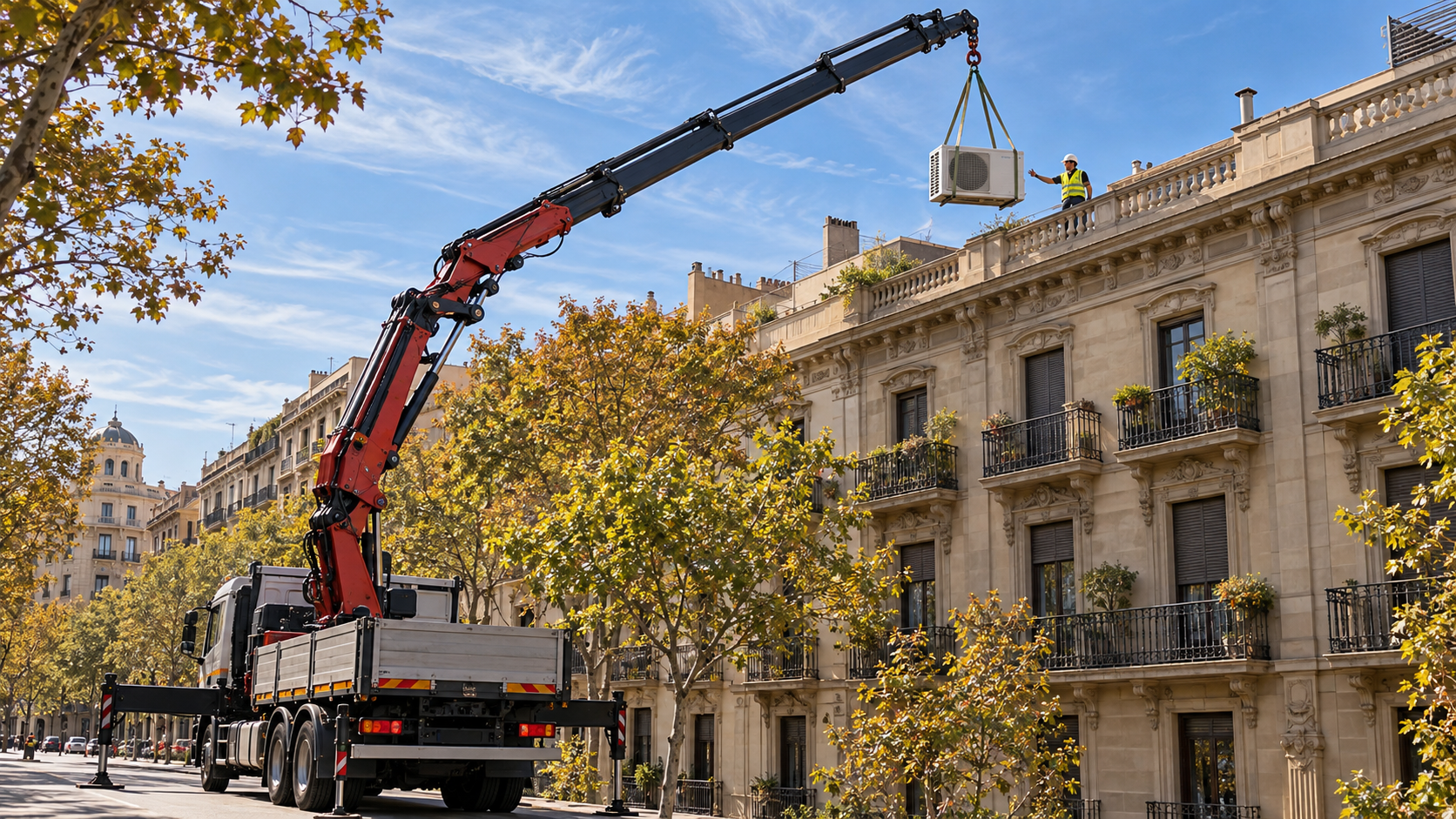
Crane truck hoisting air conditioning units to rooftops in Barcelona
An air conditioner lift to a rooftop in Eixample starts with the unit’s specifications and the building’s access conditions. First, check the weight and identify where the installer will receive the unit. In addition, review rooftop obstacles and the space available for the crane truck in the street. This helps the installer and crane operator prepare the operation together.
Lifting air-conditioning units to a rooftop with a crane truck in Barcelona is not exotic work. It is the last step of an HVAC install that usually starts with the contractor choosing the equipment, continues with the electrical and support pre-installation the installer or electrician coordinates, and ends when someone has to place a heavy unit (residential and light commercial usually sits in the 80 to 250 kg range, but the real weight comes from the spec sheet) in a place that is not always reachable by the building’s internal means. Sometimes the service lift lacks capacity, the staircase is too narrow, or a high parapet surrounds the rooftop. In these cases, the crane truck supports the installer. It does not become the main actor on site.
When an air conditioner lift needs a crane truck
Installers complete most residential installs without a crane. When the outdoor unit is small, the staircase or the inner courtyard takes it, and the installer has a team he works with daily, no external equipment is required. The crane truck comes in when one of these conditions breaks:
- Large or heavy equipment: commercial splits above 100 kg, VRF modules in the 150 to 250 kg per module range depending on the manufacturer, industrial condensers or full rooftop units. Most of these weights no longer fit a conventional staircase. Exact figures come from each model’s spec sheet.
- Limited rooftop access: the building has an internal staircase up to the fourth floor but no direct rooftop access, or the access is through a 60×60 cm hatch. Carrying the unit inside becomes physically impossible.
- Rooftop with high parapets or pergolas: when the roof is surrounded by a masonry parapet higher than one metre, the unit cannot be lifted by an internal manual block and tackle. You need a boom that works over the parapet.
- Narrow streets where a large mobile crane does not fit: in Eixample, Gràcia, Sant Antoni and Ciutat Vella many streets do not take heavy vehicles. An articulated boom crane truck, compact and with a rear steering axle, fits where a mobile crane cannot.
- Coordination with multiple trades on site: the installer works with a brick layer, an electrician and sometimes a building engineer. Halting the site for half a day to lift an outdoor unit shows up in the schedule. The crane truck shrinks that window to one or two hours.
Information needed for an air conditioner lift
To avoid wasting the trip and to keep the contractor’s morning on track, we ask the customer for a minimum of data we can verify remotely:
- Model and weight of the outdoor unit or units. The manufacturer’s spec sheet gives the exact figure: a commercial split usually sits between 60 and 140 kg, a VRF module can reach 220 kg per module, and a full rooftop unit falls in the 800 to 2,000 kg range, with boom and reach scaled to that number.
- Floor plan of the building: number of floors, parapet height, hatch existence, rooftop obstacles (antennas, solar panels, water tanks, ventilation ducts). This defines the boom height and the working radius.
- Photos of the drop point and the street: street width, overhead cabling height, parking spots for the truck, possible outrigger points.
- Residents’ association information: whether the street is private, whether the president needs to authorise the work, allowed times for unloading, existence of a permanent driveway.
- Day and time. We work between 7:00 and 18:00 on weekdays. If the site requires a special schedule for community reasons, we coordinate it.
With that information the operator can calculate the boom length, the counterweight, the outriggers, the type of sling or basket he will use, and the operation time. We almost always confirm the reach by phone before leaving the yard.
How an air conditioner lift to a rooftop works
Once on site, the sequence is fairly standard:
- Truck positioning: the operator picks the point on the street that gives the best working radius and the least traffic disruption. The team marks the area with cones. Where the street requires a parking reservation, we request it from Barcelona City Council or coordinate with local police.
- Stabilisation: the operator deploys the four outriggers of the crane truck on pads. Here we apply a non-negotiable rule: Barcelona asphalt, especially in old streets, sometimes gives way if you load all the weight on a single point. That is why we use steel spreader plates under each outrigger.
- Boom configuration: with the building height, the unit weight and the radius from the truck axis, the operator programs boom length and angle. For a six-floor rooftop with a unit in the 100-110 kg range, the boom usually works between 28 and 32 m, but the fine tuning depends on the model spec sheet and the equipment manual.
- Rigging the unit: the team rigs the outdoor unit with textile slings or a lifting basket, depending on the model. The lifting eyes on the rack, if present, are the ideal grip. If not, the team makes a sling loop around the structure, avoiding the heat exchanger and the fans.
- Lifting and orientation: the boom lifts the unit over the parapet, travels horizontally to the point on the rooftop where the installer has prepared the anti-vibration mounts, and lowers slowly. The installer on the rooftop directs the operation by radio or by agreed hand signals.
- Release and retrieval: once the unit sits on its mounts, the team releases the slings. The operator then stows the boom. Under normal conditions the operation usually falls between 20 and 45 minutes, though the real time depends on the access and the lift complexity.
Typical mistakes we see
- Confusing dry weight with lift weight. A 110 kg empty split becomes 130 kg with its metal rack and anchors. If the installer only gives us the unit weight, we are under capacity and improvisation is needed.
- Not checking the slab capacity. Not every slab takes the same load. Its capacity depends on the structure, and the site engineer must confirm it. If the installer has not verified this data, we check for spalling, cracks or an old joist slab. We pause the operation until a qualified technician confirms the capacity.
- Forgetting overhead cabling. In Barcelona, especially in Raval and Sant Pere, streets have telecom and electrical crossings at low height, several metres above the ground. A crane truck needs enough vertical and horizontal clearance with its boom extended. The team must measure both clearances to confirm that the boom can pass.
- Not coordinating the installer’s presence on the rooftop. The unit is lifted and lowered onto the mounts, but if the installer is not physically on the roof when it arrives, someone has to do someone else’s job. This happens more often than it looks and always ends with rework.
- Asking for only one hour of margin. The time calculation includes outrigger setup, signposting, lifting, orientation, lowering and retrieval. One hour is not enough. We always ask for a minimum of one and a half hours of margin.
FAQ
Do I need a permit from Barcelona City Council?
Before booking the lift, check with the city council which permits apply to the specific occupation of public space, any reserved area and possible traffic restrictions. Do not assume that authorization is unnecessary merely because the truck stays on the road. Consult the official Barcelona Guardia Urbana procedures and confirm the conditions for the planned service.
Does the installer need to be on the rooftop?
Yes, always. The person who receives the unit is the one who places it on the mounts, secures it and takes responsibility for the final positioning. We do not release the load until the receiver confirms the position.
What if it rains?
In light rain we can work, although the precision of the final orientation suffers. In heavy rain or wind above the threshold set by the equipment’s operations manual, we stop. The operator sets the exact limit on site. The safety of the operation and the people on the street admits no exceptions.
How much does it cost to lift an outdoor unit?
It depends on the weight, the building height and the street distance. We send a written quote after reviewing the unit’s spec sheet and the site access; we do not give fixed rates without those data.
Do you work with any HVAC brand?
Yes. We do the lift without touching the electrical or plumbing side. The installer handles the connection, we only do the lifting.
Do you need to lift equipment to a rooftop?
If you are in the middle of an HVAC install and you are stuck on getting the unit onto the roof, call us or write to us. We ask for the equipment, building and street data, and we send you a closed quote with date and time. We work with Barcelona and metro-area installers and we know how to coordinate with them without delaying the site.
Safety resources
In addition, consult the occupational-safety resources of the Spanish National Institute for Safety and Health at Work. The examples in this article are illustrative. They do not describe an actual job or replace the professional team’s assessment and the manufacturer’s instructions.
Leave A Comment