

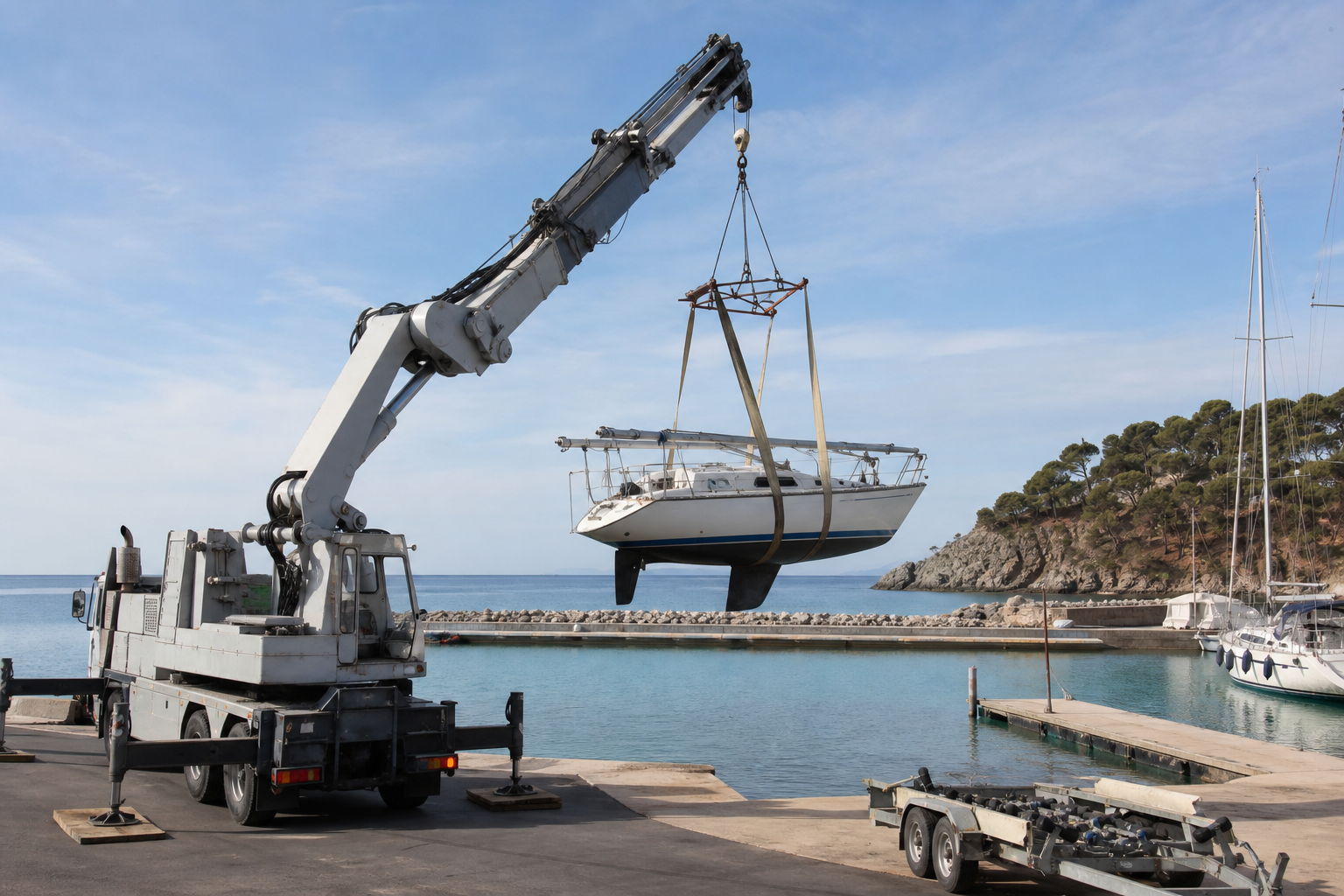
A few weeks ago a marine workshop in Port Olímpic called us with a problem that comes back every year at the end of the summer. They had a 9 metre, 4.8 ton sailboat waiting for haul out and antifouling paint, but the harbour travel lift had the ramp booked solid for the week. The dock fixed crane only covered vessels up to 6 metres. The sailboat was sitting in the water losing the good September days for hull paint. We came in with a crane truck with enough useful load, lifted her off the side of the pontoon and left her on the workshop’s own hard standing. One morning.
Moving sailboats and boats at a marina with a crane truck is not a run of the mill transport job. There is water, there is wind, there is a load that weighs and floats, and there is a pontoon with little room. That is why not every crane truck fits the bill and why coordination with the harbour master counts as much as the slings.
When a marina needs a crane truck for a vessel
The default rule in a Mediterranean marina is that the travel lift and the dock fixed crane cover almost everything. There are cases where they fall short.
When the harbour travel lift has the ramp booked up
In September and October, the travel lifts in marinas along the Catalan coast run at full capacity with end of season haul outs. Slots fill up days in advance. If a vessel needs to come out urgently (breakdown, sale, hull paint), the crane truck steps in as a second rig and frees the travel lift for routine haul outs.
When the boat outgrows the size or weight of the local travel lift
Small marina travel lifts take vessels up to 8 or 10 metres with limited beam. A 12 metre sailboat with a 3.2 metre beam and 8 tonnes does not always fit. In those cases the crane truck moves the vessel to a hard standing area on the mainland or to a larger travel lift a few kilometres away.
When the operation cannot wait for the travel lift’s window
The travel lift runs on harbour hours and tidal conditions. An urgent call for water ingress or insurance does not wait for the next slot. The crane truck steps in on extended hours, including Saturdays, and gets it done without using the travel lift ramp.
When the vessel has to be moved overland for several kilometres
Vessels that move between harbours, change marina or go back to the workshop for a long repair. The crane truck covers the road trip with the vessel on the deck, without depending on sea state or on an auxiliary boat being free.
What we ask before we close a price
A clean quote request avoids a visit to the marina and shortens our reply time. We ask the boat yard or the owner for the following.
Length, beam, weight and hull type
Length sets the sling length and the truck size. Beam limits the way through the marina access ramp and the hard standing. Weight decides whether the boom fits inside the truck’s useful load. Sailing hull with deep keel needs a cradle or support that holds the appendage and does not damage it.
Exact operating spot and type of pontoon
Floating pontoon, concrete quay, finger dock. If there are neighbouring pontoons we set the approach path. If there is a prevailing wind from the north or south we note it to set the truck position. If the marina has a narrow access slipway we measure it before we arrive.
Distance from the pontoon to the hard standing
If the vessel is lifted and stays at the marina’s own hard standing a short radius does the job. If we are transporting by road to a workshop or to another marina we add road kilometres and overweight convoy permits if beam exceeds 2.55 metres.
Type of slings available and the vessel’s lift points
Most sailboats have deck pads or lifting fittings near the mast. If they are in good shape we use certified textile slings and a two point spreader beam. If the fittings are corroded or missing, we switch to ratchet straps under the hull, with the owner’s consent.
Time slot, tide and weather conditions
In the Mediterranean the tide is small but it exists. We work on mid or high tide so the hull does not bump the bottom. Wind is measured on the spot: above 25 km/h sustained we replan the operation. We ask for an alternative date in case we have to postpone.
How the haul out manoeuvre runs on lift day
Once we have the data, lift day looks like this.
Truck arrival at the marina and coordination with the harbour master
The truck enters the harbour grounds with the harbour master’s authorisation. It positions on a solid apron next to the pontoon. The outriggers extend over load distribution mats if the ground is made up fill. Before we start, we confirm with the harbour office that no vessel or dock crew crosses the vertical of the lift.
Sling placement and balance check
The riggers place the slings on the lift points or run the straps under the hull. The crane operator checks the balance by lifting two or three centimetres before continuing. If the vessel rotates on her axis we reposition the spreader and try again. On sailing boats with a keel we lift the aft hull first so the rudder does not take the load.
Lift and transport to the hard standing
The boom raises the vessel to a safe height above quay level, swings and sets her on the hard standing supports. If the transport is by road, we tie down with ratchet straps and check the tension after the first few kilometres. The procedure is reversed to put the vessel back in the water after the haul out.
Handover to the workshop or to the owner
If handover is to the workshop, the owner signs a lift report with date, time and remarks. If it is to the marina’s hard standing, the vessel stays in custody until the relaunch date. We photograph the topsides and the hull before and after to avoid disagreement about pre existing scratches.
Common mistakes that raise cost or delay the haul out
- Asking for a quote with length only. Without beam, weight and overland distance we can only give an indicative price.
- Trusting the catalogue weight without checking the ballast on board. Real weight with batteries, water and gear can add one tonne to the plate figure.
- Forgetting the harbour master’s authorisation. Without it the manoeuvre cannot start and the day is lost.
- Assuming the travel lift is free. In September there are waiting lists of days.
- Booking with strong wind or with a storm in the forecast. It gets postponed and a date change fee applies.
Why the crane truck complements the travel lift rather than competing with it
The travel lift is the right tool for routine end of season haul outs. The crane truck steps in where the travel lift falls short: urgent calls, size, hours, overland transport. It expands the capacity of the marina and the workshop rather than replacing them.
In our case, that is how we work with boat yards, marine workshops and marinas along the Catalan coast: crane truck with the right useful load, certified slings for marine work and coordination with the harbour master before we arrive.
FAQ
What is the largest vessel you can lift at a marina?
It depends on the truck and the weight. With our usual fleet we cover sailboats up to 12 metres and 8 tonnes. For longer lengths or vessels with a beam above 3.5 metres we study the case with larger capacity cranes.
Do you work with the harbour master on permits?
Yes. We ask the harbour master for authorisation before we enter the grounds and, if the lift occupies part of the access channel, we manage the notice to nearby vessels.
Can I combine the haul out with hull paint and engine service in one intervention?
Yes, provided the workshop or hard standing has room and the engine is cooled down and disconnected. We coordinate the trades with the boat yard so the time out of the water is as short as possible.
What happens if the weather changes on lift day?
We replan with the harbour master and reschedule to the next free slot. If the operation was urgent, we aim for a 24 to 48 hour opening subject to availability.
If you have a sailboat or a vessel waiting for haul out, transport between harbours or out of the water maintenance, send us the length, the beam, the approximate weight and the marina she is in. We reply on the same business day and, if the lift fits, we come to see her before the date.