
Last year we set up a 4×3 metre stage on a Maresme beach in the small hours of a Thursday morning. The production company had allowed six hours of margin and, in the end, everything was standing by half past five. The difference was not having a bigger truck. It was having understood, in advance, what was being assembled, how much it weighed and how much room there was to park.
At events, a crane that arrives late or with just enough capacity turns a relaxed setup into a night of nerves. And the reverse also holds: with the right information, the job runs so smoothly nobody even notices.
What kind of setups a crane truck handles at an event
The crane truck covers three broad families of jobs at an event. Almost always it falls into one of these:
Stages, platforms and backline
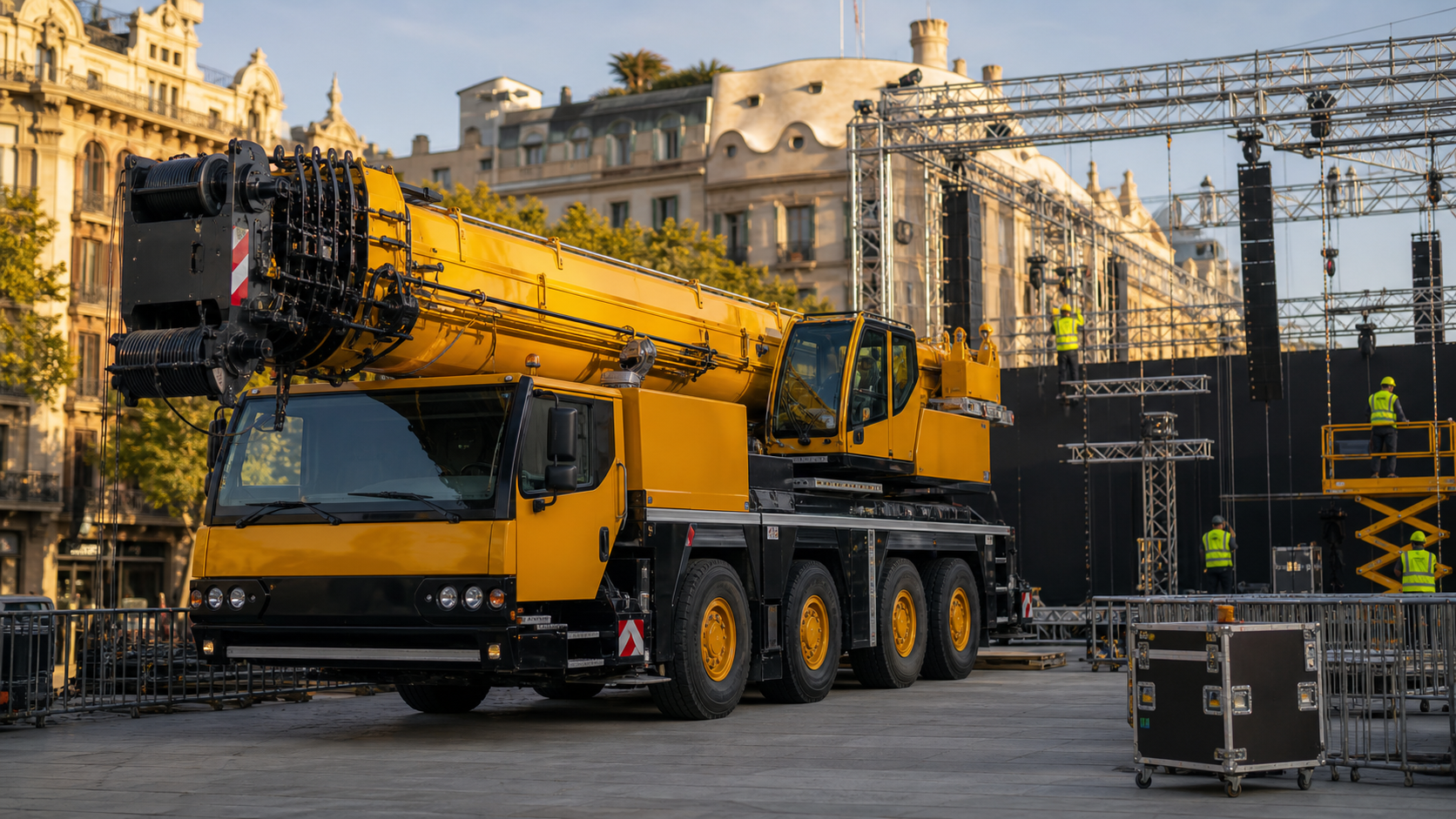
Lifting the stage into a square or a car park, levelling the platform, placing PA cabinets and heavy backline. This is the most common use at fairs, concerts and town festivals. What matters here is the rhythm: the build has to be quick to keep clear of the rehearsal window.
Light structures, arches and advertising rigging
Finish-line arches, entrance arches, supports for banners, small truss for lighting. These pieces are lighter but bulkier, and sometimes they have to be lifted horizontally and turned in the air to clear trees or lamp posts.
Stands, seating and bulky pieces
Tiered seating, box seats, large set pieces. Here the crane truck covers what a forklift or pallet truck cannot do by volume or by weight.
Key information to request a quote without errors
A clear brief avoids the operator turning up with a machine that does not fit, or one that falls short. We usually ask production companies and agencies for the following:
Weight, dimensions and lifting points
A rigid finish-line arch can weigh between 250 and 600 kg. A 6×4 metre stage platform comes in around 400 to 800 kg depending on the material. A 4-metre truss structure, between 80 and 200 kg. Without that data we can only give an estimated price.
Available space and street schedule
Working in a closed car park at three in the afternoon is not the same as working on an Eixample street at six in the morning, before the bars open. The space, the time window and the noise allowance all change the logistics and the cost.
Municipal permits and coordination with the production team
In Barcelona, setting up a structure in the street requires a space reservation and, depending on the case, authorisation from the district or a prior notification. The Guardia Urbana controls traffic cuts. A good production company already has that paperwork sorted, but if not, we handle it within the deadlines set by the city council.
How the crane truck is coordinated with the production team
Coordination starts the day before. We confirm floor plans, weight per piece, setup sequence and the spots where the truck can rest the outriggers. When there is a truck, a crane and the production company riggers, all three teams work from the same route sheet.
On the day of the event, the crane operator shows up with the truck, the outriggers extended and the slinging gear ready. The production manager marks the order of the pieces. The production company rigger receives and fixes. Communication runs on the event’s internal radio. If anything slips, we talk it through live, not on WhatsApp.
Typical mistakes that complicate the setup
- Booking the truck for a time slot that is too tight. Any delay from the previous supplier blocks the whole chain.
- Forgetting the traffic cut or the parking reservation. In Barcelona there are streets where the truck cannot stop without authorisation.
- Confusing catalogue weight with real weight once extra pieces are added. A structure advertised as light can carry motors, lights or banners that add 100 kg.
- Trying to handle two setups at the same time with the same truck. Better to prioritise one and leave the second for a second run.
- Quoting as if it were a construction job and not an event. Here the time pressure and the pace are different.
Why choosing an operator who already knows events matters
An industrial crane works for a factory manoeuvre, but at an event the rules change. The truck manoeuvres around the public, streets are narrow and time is tight. An operator used to events understands that a stage is not rehearsed twice and that moving a piece to the wrong spot costs thirty minutes to put right.
At Adik Gruas we have spent years working with production companies in Barcelona and the metropolitan area: fairs, concerts, town festivals, advertising setups. We know how to read a floor plan, how to talk to a stage manager and how to recover when something goes sideways.
FAQ
How far in advance should you book? For events in central Barcelona, two to four weeks. At fair venues with a fixed date, a month is better. For emergencies we can respond in 24 to 48 hours if we have availability, but that is not the norm.
Can the truck drive into pedestrian streets? It depends on the width, the total weight and the municipal permit. We assess it case by case. In narrow streets of the Gòtic or the Born we usually work in the early morning to avoid clashes with terraces and outdoor seating.
Can you set up and dismantle on the same day? Yes, if the schedule allows it. The trick is keeping the truck support area clean for the return run. If there is an audience in between, a pre-build is done nearby and everything is moved in one go at the changeover window.
What happens if it rains? Work can continue in light rain. With an electrical storm, the manoeuvre is paused until the front passes. Safety comes before the schedule.
If you are running an event in Barcelona and need a hand with the lifting side, send us the floor plan and the timings through the contact form. We usually reply the same day and, if it looks like a fit, we come to see you at the venue before the date.