

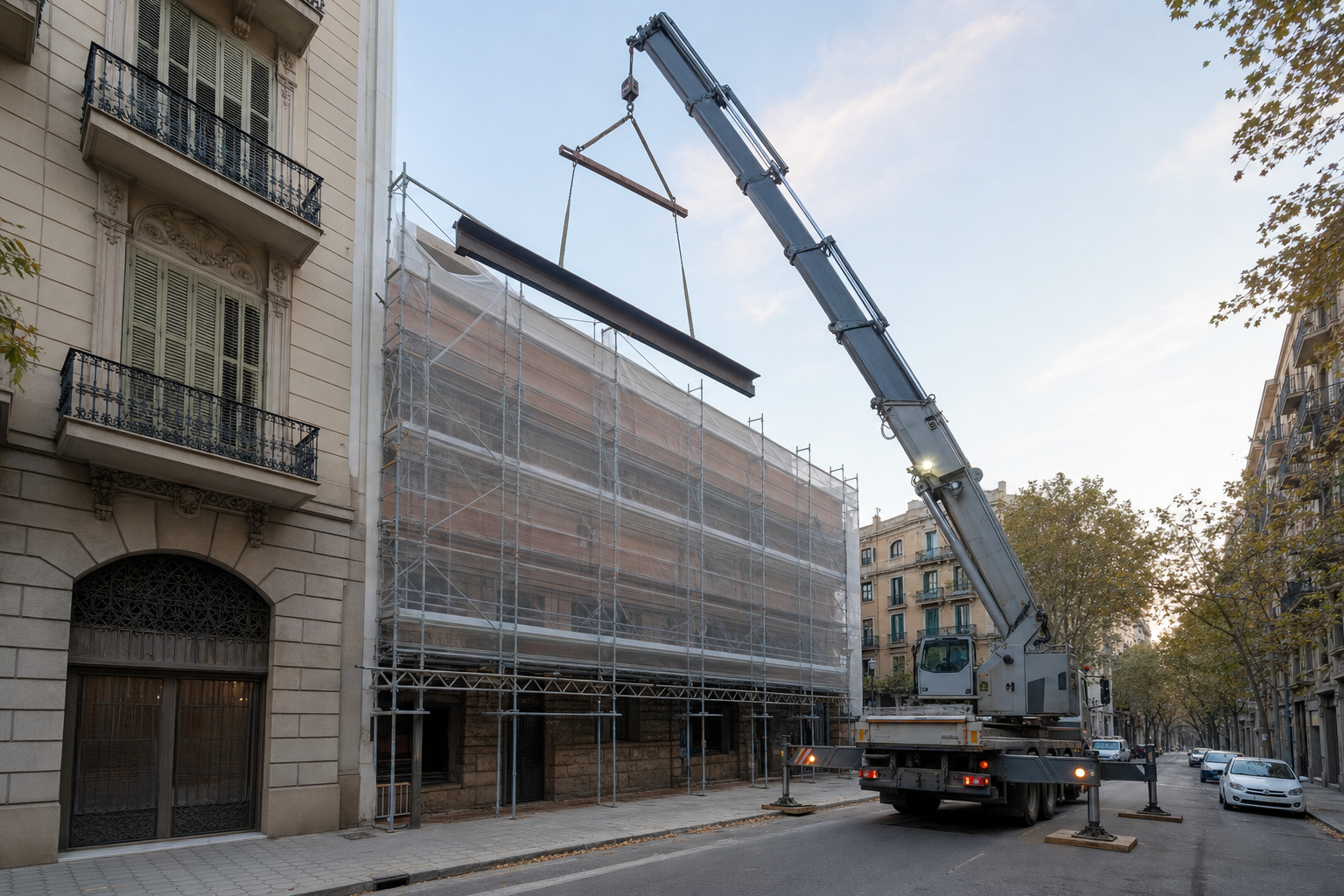
A construction company in Poblenou called us at the end of August with a job that captures this kind of work well. They had to lift a 2.2 ton steel girder to the third floor of a building under refurbishment, on a street where the jobsite tower crane was down for repairs. The lowboy trailer could not fit, the hoist ramp took only one metric ton, and the street had a works permit for the kerb reserved until ten in the morning. The crane truck was on site at seven, lifted the girder over the facade and set it on the slab in forty minutes.
Crane truck lifting of steel structures and prefab concrete on a jobsite does not look like a household move or an open-sky industrial job. The space is tight, the contractor is watching the clock, and the pieces cannot be fumbled because they have already been paid for. The operator’s experience matters more than the spec sheet of the boom.
When a contractor needs a crane truck instead of the jobsite tower crane
The most common question when planning a lift is whether the tower crane already set on the site can handle the piece. Almost always it can, until it cannot.
When the jobsite crane is down or short on capacity
Tower cranes down for repairs, with wind load limitations, or dismantled after the structural phase. It also happens when the piece arrives after the dismantle and reassembling the tower costs more than hiring a crane truck for a single day. In those cases we act as an outside crane, in and out by lunchtime.
When the piece enters through a street the tower crane cannot cover
Beams and girders that come into site from a side street, perpendicular to the reach of the tower crane. The working radius of a mid size tower covers around 30 to 40 metres. If the piece falls outside that radius you need a second rig. That is where the crane truck comes in, set up where needed and lifting without auxiliary structure.
When the piece weighs more than the construction hoist can take
Standard jobsite hoists handle 800 to 1.500 kilograms. A 2 ton steel girder does not ride up in one. Neither does a prefab bathroom or kitchen module at 1.500 to 3.000 kilograms. The crane truck lifts them from the street or from the jobsite yard to the slab, without going through the stairwell opening.
When the refurbishment leaves little vertical room
In refurbishments in Eixample, Gràcia or Sant Antoni, interior courtyards have drying racks, visible services and narrow widths. The crane truck boom reaches in from the street, passes over the neighbour’s roof if needed and sets the load on the courtyard or the slab. This requires a prior study of the vertical path with the site architect or the project manager.
What we ask the contractor before we close a price
A good quote request saves a prior visit and reduces the margin of error. Contractors send us the following.
Piece datasheet with real weight and dimensions
The catalogue model is not enough. We need the actual weight of the girder, beam or module with its stiffeners and accessories. An IPE type girder with gusset plates can add 200 kilograms on top of the base profile weight. If the contractor does not have that number, we work it out from drawings and the maker’s table.
Jobsite plan with the piece position and the truck’s outrigger pad
The contractor sends a floor plan with the facade, the interior courtyards and the point where the outrigger sits. This decides whether the truck drives in nose first, sideways, or in reverse. It also decides whether the street has to be cut off or just the kerb occupied.
Free height from the outrigger up to the slab or roof
We add the outrigger height, boom length, weight and radius. The contractor confirms the slab elevation and the height of the neighbour’s building if the piece passes overhead. If there is a low voltage cable between the street and the facade, we measure it with a hot stick and we write it down.
Type of sling or spreader beam required
For pieces with two pick points we use textile slings and a spreader beam. For prefab modules with a single pick point we use shackles and a sling with a master link. The contractor usually has this set in their lifting procedure. If they do not, we set it with the site architect.
Available time slot and active permits
In Barcelona, town halls limit crane working hours in dense residential areas and jobsites with neighbours. We work between seven and ten in the morning or on Saturdays. If the project already holds a municipal permit for the kerb or for the street occupation, we ask the client for it and we cross check it with the local police.
How a steel structure lift on a jobsite is run
Once we have the data, lift day usually goes like this.
Truck arrival and outrigger setup
The truck drives in and parks over the planned pad points. Outriggers extend to the maximum allowed by the layout plan. If the street is not flat, we use load distribution mats and we measure the pressure on the asphalt with a portable dynamometer.
Slinging the piece and balance check
The contractor’s riggers place the slings or the spreader beam on the pick points defined earlier. The crane operator checks the balance before lifting, raising the piece a few centimetres and confirming there is no sideways drift. If the piece is not balanced, we reposition the spreader and try again.
Hoist and swing to the vertical of the slab
The boom raises the piece, swings and carries it to the vertical of the slab or of the interior courtyard. If the piece passes over a neighbour’s building, we run a dry cycle to confirm clearance. Hoist speed stays low so the contractor can correct with hand signals from the slab edge.
Lowering, landing and sling release
The piece is set on the planned packers or anchor plates on the slab. The contractor fixes the piece with bolts or welds per project. The operator removes the slings only once the piece is fixed. If the welding or the bolting takes more than an hour, we programme a second lift or we hold the boom in place with a waiting cost.
Common mistakes that inflate cost or stall the lift
- Asking for a quote with weight only. Without a jobsite plan and free height, we can only give an indicative price.
- Trusting the catalogue weight without adding stiffeners, gussets and accessories. The girder weighs 300 kilograms more than expected and the crane truck is undersized.
- Forgetting a low voltage cable crossing the street. The boom cannot pass and the truck has to be moved or the cable has to be cut by the utility.
- Assuming the tower crane covers the whole site. The tower does not reach the back of the courtyard and the piece sits on the ground until someone calls in a second rig.
- Booking the exact delivery day of the prefab with no margin. If delivery slips, the slot is lost and we have to reprogramme with an extra charge.
Why combining lift and transport with the same operator pays off
When the transport of the prefab and the lift are hired from two different providers, the first drops the piece on the street and the second charges a waiting fee to pick it up. When the same operator does both with the same truck, the prefab travels from the workshop to the site, gets hoisted and gets installed in a single run with a single point of accountability.
In our case, that is how we work with contractors, developers and prefab workshops in Barcelona and the metropolitan area: crane truck, single operator and coordination with the site architect or project manager so the lift holds to the contractor’s schedule.
FAQ
Can a crane truck replace a tower crane for an entire project?
No. The crane truck covers one-off pieces and short refurbishments. For structural projects with several dozen pieces the tower crane is still more efficient. We work as a single-purpose complement.
Can you lift prefab pieces into interior courtyards with no facade opening?
Yes, if the courtyard has an operable skylight or an operable roof section larger than 6 square metres. We study each case with drawings and with the site architect.
Do you work on Saturdays or overnight?
Yes, subject to availability and with a surcharge. On projects with tight deadlines we open a Saturday morning slot.
Do you take pieces back down for replacement or repair?
Yes. If the original piece has to go back to the workshop, we plan the lift down and the transport with the same operator and the same rigging.
If you have a girder, a beam or a prefab module that cannot wait on site, send us the piece datasheet, a plan marking the position and the time slot you have free. We reply on the same business day and, if the piece fits, we come to see it before the date.