

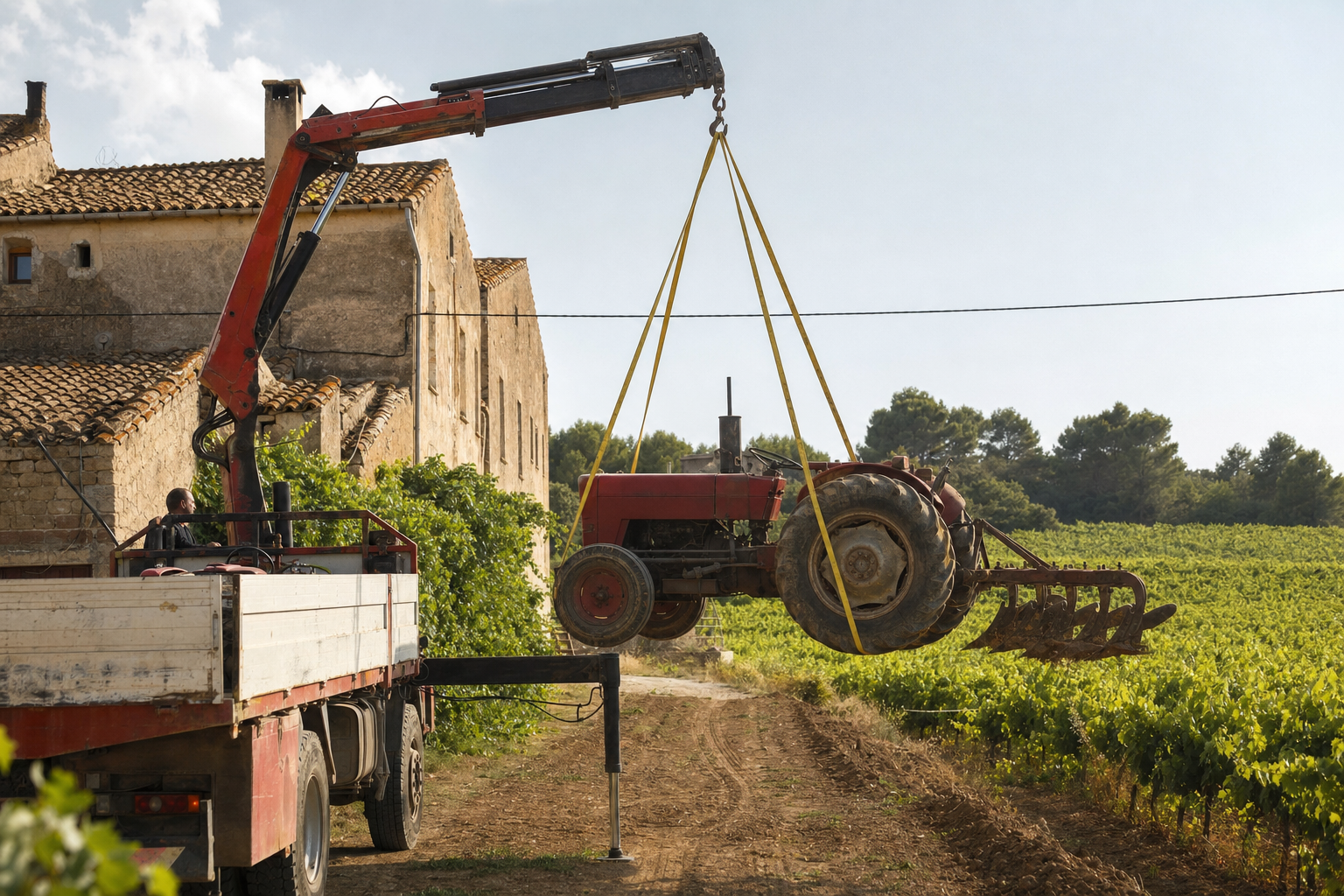
A few weeks ago a farmer from Penedès called us with a problem we see more often than people think. He had a 4.2 tonne tractor stranded at a masia with a broken clutch, on a forest track where a standard low-loader does not fit. He needed it at the workshop before the grape harvest. His neighbour’s trailer could not handle that weight on that surface. A crane truck with an operator who knew the area sorted out the morning.
Moving agricultural machinery with a crane truck is not the same as shifting a harvester between two flat fields. Farms have dirt tracks, slopes, lane widths that do not appear on Google Maps and, sometimes, low overhead power lines. That is where experience matters more than the vehicle spec sheet.
When a tractor or harvester needs a crane truck and not a low-loader
The most common question is whether a standard low-loader or farm trailer is enough. It usually is, until it is not.
Weight that exceeds a farm trailer’s limits
A mid-size tractor with loader and wheel weights sits around 4 to 6 tonnes. A self-propelled grape harvester, between 8 and 14. A large cereal combine, 12 to 18 tonnes with the header attached. Past a certain weight, a farm trailer needs more axles than most farmers carry, and moving it on public road gets messy with roadworthiness tests and convoy width.
Farm accesses that defeat a low-bed trailer
Hydraulic low-bed trailers are comfortable on the road, but they need long ramps and a solid surface. On forest tracks with a slope, at masia entrances with tight bends, or on farms with narrow fords, the ramp simply does not fit. A crane truck loads from above and holds the tractor or harvester in the air without needing a ramp.
Breakdown or missing wheels that stop the machine from rolling
When a tractor does not start or has no wheels, it cannot be winched onto a trailer. It has to be lifted. Same for a machine that is partly dismantled for an in-field repair.
Moving implements or machines between farms
In Penedès and Alt Penedès, shifting implements between farms a few kilometres apart is common. If the distance does not justify a semi-trailer but the machine is heavy, a crane truck on a short run is quicker than assembling and disassembling a low-loader.
What we ask before quoting a firm price
A good job starts with data the farmer already has on hand. We usually ask for the following.
Approximate weight and dimensions of the machine
Factory precision is not required. A registration document or a photo of the plate is enough for the operator to decide whether it fits inside the truck’s useful capacity. For machines without paperwork, a few photos at three angles with someone standing next to the machine for scale is fine.
Exact pickup point and type of access
Tarmac road, dirt track, forest path, masia entrance with a tight bend. If there is a gate, we note whether it opens inwards or outwards and its usable width. It also helps to know whether the truck can drive in and turn around, or whether it has to work in reverse.
Distance between pickup and delivery
The per-kilometre cost changes the final figure significantly. For runs within the same county (Penedès, Anoia, Baix Llobregat) we usually charge differently from a run from Lleida or Tarragona.
Power lines, trees and other overhead obstacles
In vineyard areas with low-voltage lines strung between farms, the clear height has to be measured. Same for branches touching the line. If the line crosses exactly where the load would hang, we look at an alternative angle or arrange a temporary cut with the utility company.
When the machine needs to be at its destination
Grape harvest and cereal harvest set short calendars. If delivery has to land before a specific date, give us a week or ten days’ notice. For breakdowns we try to fit it in within 24 to 48 hours if we have availability.
How an agricultural transport with a crane truck actually runs
Once we have the data, the day of the manoeuvre looks like this.
Visual check of the loading point
The operator looks at where the outriggers rest, where the truck parks and how the lifted load will clear the area. If the track is narrow, several forward and reverse moves may be needed. This is planned in advance by phone with the farmer if needed.
Slinging and lifting the machine
Textile slings are used at the anchoring points of the tractor or harvester. For smaller implements (ploughs, sprayers, mowers), the lift uses slings and shackles. If the machine has moving parts (combine header, sprayer booms), they are locked or dismantled before the lift.
Loading on the truck and lashing
The truck lowers the arms, sets the machine on the platform and secures it with ratchet straps. For long hauls, strap tension is checked at the first stop.
Unloading at destination and handover to the farmer or workshop
The operator chooses where to place the machine based on the customer’s instructions. If the delivery is at a workshop, there should be room for the mechanic to move it without having to unlash it all over again.
Common mistakes that inflate the cost or block the job
- Asking for a quote with only the type of machine. Without weight, without a photo and without an exact address, we can only give an indicative price.
- Forgetting overhead cables. A low-voltage line crossing the track sometimes forces the truck to shift position by a few metres.
- Assuming the neighbour’s low-loader will do. If the machine is heavier than the trailer’s gross vehicle weight, the trailer falls short.
- Not telling us about the breakdown. A tractor with no clutch cannot be pushed up the ramp; it has to be lifted directly.
- Booking during grape harvest at short notice. That window fills up quickly and slots run out fast.
Why combining transport and lifting with a single provider pays off
When a farmer hires the machinery transport and the crane lift from two different providers, the first one drops the machine on a flat area and the second charges a waiting fee to pick it up. When the same operator does it with the same truck, the machine goes from field to workshop in one run, with one invoice and one point of contact if something goes sideways.
In our case, that is how we work with farmers and cooperatives in Penedès, Anoia and Baix Llobregat: one crane truck, one operator and full coordination with the workshop or the destination farm.
FAQ
Can a full harvester be lifted with the crane truck? It depends on the model and weight. Many self-propelled grape harvesters, yes. For large cereal combines we assess case by case and sometimes a low-loader semi-trailer is needed instead of a standard crane truck.
Do you take machinery anywhere in Catalonia? Yes, within reason. For long distances (Lleida, Tarragona, Girona) we adjust the per-kilometre rate and usually combine with other jobs on the same day.
Can I book for a Saturday or Sunday? Yes, with a surcharge and subject to availability. During grape harvest and harvest season we usually run weekends.
Do you also handle the return trip once the machine is repaired? Yes. If delivery was to a workshop and pickup is at the same point, we plan the return with the same operator.
If you have a tractor, a grape harvester or an implement that cannot wait, tell us the approximate weight, the exact pickup point and when you need it. We usually reply on the same working day.